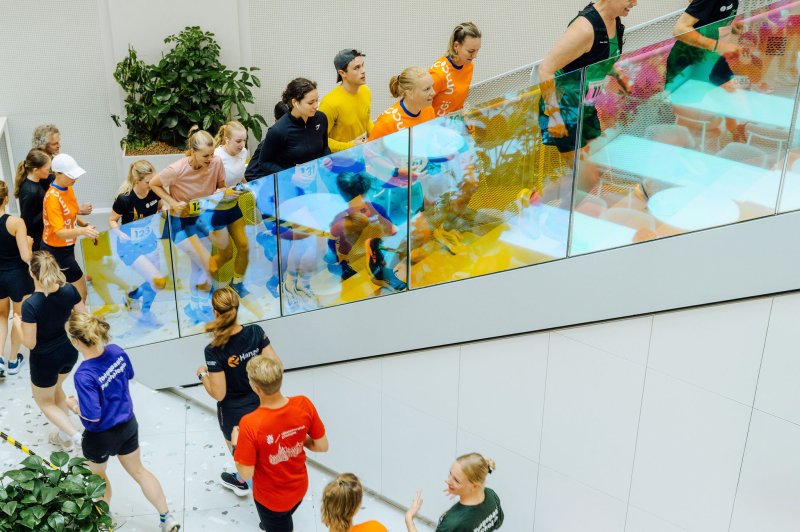
Op zondag 31 mei 2026 staat Groningen in het teken van sport, doorzettingsvermogen en betrokkenheid. Tussen alle lopers is ook het herkenbare roze van Vrienden Beatrix Kinderziekenhuis zichtbaar.
The LIFE Cooperative, part of the Northern Netherlands life sciences ecosystem at Campus Groningen, is organizing the Dutch Medicines Winter Afternoon together with FIGON on Thursday, 26 February. This fully booked event brings together leading scientists and industry experts to explore the latest developments in innovative medicines and advanced drug delivery. Read the full article as published by the LIFE Cooperative.National Attention for Sold-Out Dutch Medicines Winter Afternoon: Innovative Medicines and Advanced Drug Delivery Take Center Stage in Groningen Innovation in medicines takes center stage on Thursday, 26 February during the Dutch Medicines Winter Afternoon, an inspiring event organized by FIGON (Federation for Innovative Drug Research Netherlands) in collaboration with the LIFE Cooperative. “We are extremely proud of the strong line-up at this event, bringing together leading experts from science and industry to explore the frontiers of drug development. The fact that registrations are already fully booked underlines the great importance of this event for the life sciences ecosystem, and in particular for the Northern Netherlands,” says Ronald Hesse, Director of the LIFE Cooperative. The Dutch Medicines Winter Afternoon brings together scientists, innovators, and professionals from across the Netherlands for an afternoon of insights, knowledge exchange, and networking opportunities. The speaker line-up features experts from both academia and industry. This event is already fully booked. Interested in joining the waiting list? Please email: amber@lifecooperative.nlConnecting force The afternoon will be opened by Prof. Klaas Poelstra of the University of Groningen (RUG), Chair of FIGON, who will outline the importance of innovative drug development in the Netherlands. This will be followed by an introduction by Robert Hof on behalf of the LIFE Cooperative, highlighting the cooperative’s role as a connecting force within the regional ecosystem. The first session block before the break focuses on innovation in drug delivery systems. Rob Steendam (CTO, InnoCore) will discuss the development of long-acting SynBiosys® microspheres for controlled and sustained drug release. Jaap Wieling (CEO, PureIMS) will present the potential of dry-powder inhalation via the Cyclops® technology for both pulmonary and systemic indications. From an academic perspective, Prof. Marleen Kamperman (University of Groningen) will explore the potential of polyelectrolyte coacervates as innovative drug delivery platforms.Deep dive After the break, the focus shifts to advanced nanomedicines and clinical development strategies. Dr. Flávia Sousa (RUG) will present her work on polymer-based nanomedicines for the delivery of biotherapeutics to the brain. Dr. Ad Roffel (ICON plc, Groningen) will address mass balance and absolute bioavailability studies with ¹⁴C-labeled drugs in humans, an essential component of clinical drug development. Prof. Erik Frijlink (RUG) will reflect on the value of innovation within both established and advanced drug delivery systems, placing technological progress in a broader pharmaceutical context. Finally, Prof. Helder Santos (RUG) will demonstrate how nanomedicines are being used for RNA delivery in myocardial infarction repair, a promising development in cardiovascular therapy. “We are extremely proud of the strong line-up at this event, bringing together leading experts from science and industry to explore the frontiers of drug development. The fact that registrations are already fully booked underlines the great importance of this event for the life sciences ecosystem, and in particular for the Northern Netherlands." - Ronald Hesse, director LIFE CooperativeClosing and networking The afternoon will conclude with a contribution by Peter Ketelaar (LIFE Cooperative), followed by closing remarks from Prof. Klaas Poelstra. Participants will then have the opportunity to connect and continue discussions during the networking reception. Hesse looks forward to the event: “With this event, FIGON and the LIFE Cooperative underline the strength of collaboration between academia, industry, and clinical practice. The Dutch Medicines Winter Afternoon promises not only to be an inspiring afternoon, but also to provide momentum for further innovation and collaboration within the Northern Netherlands life sciences ecosystem.” Text: lifecooperative.nlPhotographer: Casper Maas
The master plan for the Healthy Ageing Campus has officially been approved! This marks an important step in developing the campus as a hub for knowledge, innovation, and collaboration. With a focus on greenery, health, and connection to the city, the campus will become a vibrant environment where research, education, healthcare, and business come together. The vision provides space for new laboratories, building renovations, meeting places, and closer collaboration between UMCG, RUG, and the business community. Read the whole article by the UMCG below.Green light for the Healthy Ageing Campus Master Plan On Wednesday, 18 February 2026, the Groningen City Council formally approved the master plan for the Healthy Ageing Campus. This is a major milestone, as the plan provides the framework for the campus’s further development and its integration with the surrounding area. At the end of last year, the University of Groningen (RUG), the University Medical Center Groningen (UMCG), and the City of Groningen presented an ambitious, future-proof plan for the campus. Shared ambitions have been translated into coherent spatial and programmatic guidelines for current and future developments. In other words: how much space is available for which functions on the campus, and where is the most suitable location for them? The renewed campus will: Provide space for knowledge, innovation, and collaboration, encouraging interaction between disciplines and people; Connect with the city, making the campus a natural part of Groningen life; Be a healthy and sustainable environment, with attention to greenery, physical activity, wellbeing, and a living environment that supports health; Be lively and accessible, bringing together living, working, research, studying, and healthcare.Next steps The master plan is not only a blueprint for the future, but also a concrete step toward further developing the current campus. Construction and renovation on the UMCG and RUG grounds are ongoing, and each project must now be assessed to determine what is possible. With the approval of this master plan, the way is cleared for follow-up decisions, including applying for demolition and building permits and further project development within the area. Upcoming projects include: The construction of the Central Laboratory for Diagnostics and Research (CLDR): a new laboratory building on the site of the former UCP building. This building will bring together various laboratories in one location to improve collaboration. Relocating laboratories from the Central Medical Complex is also necessary for the renovation and expansion of several hospital departments; Renovation and future-proofing of existing UMCG and RUG buildings, with attention to sustainability, flexibility, and integration with the heating/cooling system; Making the campus greener and more accessible, creating new meeting places and better connections to surrounding public spaces; Creating space for campus-related business activities, strengthening collaboration between UMCG, RUG, and the private sector.Municipality explores the future of DOT Initially, the master plan covered the area between Petrus Campersingel and Oostersingel, from Hanzeplein to the Oosterhamrikkanaal. In the newly approved plan, the Bodenterrein site has been separated, as the municipality is investigating the costs of possibly preserving DOT. More information on this will be available later this year. Read more about the Master Plan.Source text and pictures: umcg.nl
Good news! Hanze researcher Allard Roest has been nominated for the Klokhuis Science Prize thanks to his research into how people can make a difference in extreme weather conditions with their own gardens; Hanze highlights this in the article below.Hanze researcher Allard Roest nominated for Klokhuis Science Prize Researcher Allard Roest from the Climate Adaptation research group has been nominated for the Klokhuis Science Prize 2026. As a child, he always watched Het Klokhuis, and now he is one of the ten finalists in the running for the prize. Allard has been nominated for his project Dry feet, cool heads: extreme weather in your garden & street. Part of the project was the Measure the Rain experiment. A total of 850 families discovered during the experiment which gardens are better able to withstand heat or rain. The insights help to make gardens and houses weatherproof, liveable and playable - with the garden as a laboratory. Tiled gardens cause flooding, bubbling drains and scorching hot stones; green gardens do exactly the opposite. 'Now that we know this, we can work together to ensure that you can sleep well or play outside in extreme weather, both now and tomorrow!'Citizen science Climate change does not stop at the fence. Heat, flooding and extreme rainfall directly affect residents. And you can make a difference and actively participate! That is why Allard enjoys working with residents and young people. Through citizen science, he investigates heat in bedrooms, rainfall patterns and the influence of gardens on nuisance, among other things. Allard gives guest lectures at schools and to resident groups, showing people that climate adaptation is not just a task for local authorities, but for everyone. Because ultimately, it is not the local authority that ends up with wet feet or sleepless hot nights... but the residents themselves.Working together towards a weather-proof city Allard is a PhD candidate at the Faculty of Spatial Sciences (University of Groningen). For years, Hanze University of Applied Sciences and the University of Groningen have been researching how cities deal with extreme weather. We test measures, flood streets in a controlled manner and develop tools for municipalities. But one thing keeps becoming clear: real climate adaptation only works if residents participate.Polling station open Voting for the Klokhuis Science Prize 2026 is now open. The winner will be announced on 8 March during the Science Festival in Nijmegen. Source text: Hanze
The marathon distance of the Marathon Groningen powered by Campus Groningen is sold out. All 2,500 starting places for the 42.195 kilometers were sold at a rapid pace. This once again confirms the need for a full marathon in the city of Groningen and the growing popularity of running events in the region. The marathon route, which consists of one lap around the city center and through the northern and southern outskirts of Groningen, has been well received since its announcement in December. The course showcases both the diversity and charm of the city, making it an attractive setting for experienced marathon runners and debutants alike. Zernike Campus Groningen is the innovative location where both the start and finish will take place.Think big, act big A marathon requires vision, endurance, and the ability to maintain pace. These are precisely the qualities that are also necessary for economic development. At Campus Groningen, we work every day on innovations that cannot be achieved in a single sprint, but require a long-term approach. We think big here and take concrete steps forward. The fact that the start and finish of the marathon take place here underlines what the campus and this region stand for: dynamism with perseverance," says Lisanne Brakenhoff, manager of Campus Groningen.Interest list opened Due to the high level of interest, an interest list has been opened. Interested parties can sign up here to stay informed in case a limited number of starting places become available at a later date. Signing up for this list does not guarantee that starting places will actually become available. This will depend entirely on the number of places that become available.Sign up now for the half marathon, 10 km, and Kids Run (2.5 km) Although the marathon distance is already sold out, there are still plenty of starting places available for the other events. Participants can still register for the Half Marathon, 10 km, and Kids Run (2.5 km). Together with the marathon, these events form a complete program for runners of all levels and ages. On Sunday, May 31, 2026, Groningen will be transformed into one big running party. With a revamped course for the Half Marathon distance, a wide range of distances, and strong collaboration with local partners such as Campus Groningen, the event promises to be a sporting milestone.Collaboration between Marathon Groningen and Campus Groningen Campus Groningen is once again partnering with the Marathon this year. As with the previous half marathon, the start and finish will take place at the Zernike Campus. Campus Groningen and its partners are once again making a valuable contribution as supporting partners. The charity benefiting from this edition is Vrienden Beatrix Kinderziekenhuis. A marathon requires vision, stamina, and the ability to maintain pace. These are precisely the qualities that are also needed for economic development. At Campus Groningen, we work every day on innovations that cannot be achieved in a single sprint, but require a long-term approach. We think big here and take concrete steps forward. The fact that the start and finish of the marathon take place here underlines what the campus and this region stand for: dynamism with perseverance. - Lisanne Brakenhoff, Campus Manager Groningen
After eight years, Brigitte Hofstee is saying goodbye to Brasserie Zernike (now Contini Zernike) at Campus Groningen. On 1 February, she handed over the keys to her successor, René Contini. What started as a leap into the unknown grew into a place where hospitality, entrepreneurship and the campus community came together. “We’ve truly built something here together,” says Hofstee. In this interview, she looks back on her years at the campus.Eight years of Brasserie Zernike Hofstee took over Brasserie Zernike on 1 March 2018. Shortly after, the coronavirus pandemic broke out. Yet she does not look back on that period negatively. “It was incredibly educational. It brought me a lot and taught me a great deal.” The brasserie became a regular meeting place on campus for staff, students and entrepreneurs. “That dynamic: people working, studying and running businesses here, is what made this place so special.” The decision to pass on the baton came gradually. “I worked an average of seventy hours a week. At some point, that takes its toll,” Hofstee explains. What weighed heavily on her was her team. “It was very important to me that my employees would also have a secure future. That’s why I spoke with them first. They fully understood my decision, and that gave me peace of mind.” She was not too concerned about finding a successor. “Daytime hospitality businesses are popular among entrepreneurs. But I felt it had to be someone who truly connects with the campus. We all work hard here to be visible and welcoming — you need to feel that as well.”From Hanze to hospitality Before moving into hospitality, Hofstee worked for nearly fifteen years at the Hanze in Groningen in various support roles. “From preparing accreditations to guiding students going abroad. Planning, organising and being hospitable — I was already doing that there.” With a background in business administration, she had always had a quiet ambition. “If I were ever to run a daytime hospitality business, it would ideally be in a setting that combines companies and institutions. When Brasserie Zernike crossed my path by chance, I didn’t have to think twice.” “That dynamic: people working, studying and running businesses here, is what made this place so special.” - Brigitte Hofstee, former owner Brasserie Zernike (now Contini Zernike)Entrepreneurship is building together In addition to her role as a hospitality entrepreneur, Hofstee was a visible and active member of the campus community. “What made my work enjoyable was building something together with others. That’s what we literally do on campus — everyone at their own level, macro or micro.” Over the years, she saw engagement grow. “The support for entrepreneurs from Campus Groningen and Bedrijvenvereniging WEST has increased tremendously. That makes you want to give something back.” That sense of reciprocity is what she will miss most. “The shared commitment to giving the campus a welcoming character.” She has also seen a positive development among companies. “More and more businesses are joining campus activities. You can tell they find it important to belong and to be visible.” Events such as the Campus Café, the Campus Trail and the Marathon Groningen powered by Campus Groningen reinforce that sense of community. Hofstee actively encouraged collaboration among entrepreneurs. “Why source products or services outside the campus when we have so much to offer here? When I was too busy, I outsourced work to other entrepreneurs on campus. That way, you keep it within the community.”Advice for new companies Hofstee has a clear message for new companies on campus: get involved. “Join activities, even if they are not directly related to your field. You’ll meet people who play a role here and hear what’s going on.” Her advice is to connect with Campus Groningen and Bedrijvenvereniging WEST. “Even if you first take a look around — it’s truly worthwhile. You get a lot in return.”‘First, I promised my husband some rest’ Since 1 February, Hofstee has officially stepped down. “I feel like I’m playing truant,” she says with a laugh. “After being ‘on’ every day for years, it’s very strange to suddenly be at home.” At the same time, it gives her energy. “New ideas are already bubbling up.” She is closely following developments around Groningen as a conference destination and welcoming city. “I see opportunities for myself there, perhaps as a self-employed professional, helping companies or institutions further professionalise their hospitality. I don’t yet know exactly how.” First, it is time for rest. “I promised my husband that. And I can tell — it’s doing me good.” Finally, Hofstee expresses her appreciation. “Campus Groningen, Bedrijvenvereniging WEST, the Hanze and the RUG are truly putting this place on the map. Entrepreneurs feel supported here. I have always found that incredibly valuable.” And for her successor René, she has one heartfelt wish: “That he will have just as wonderful a time on campus as I have had.” Text Campus Groningen (interviewer Marlies Schipperheijn)Photo: Brigitte Hofstee, copyright STOK MEDIA
Rijksuniversiteit Groningen (RUG), Hanzehogeschool Groningen (Hanze), ACLO, Hegeman Bouw & Infra and Royal BAM Group have signed the construction agreement for the new Sports Centre. The first pile will be driven into the ground in spring 2026, and in 2028 students and staff will be able to make use of the modern, sustainable facilities. Read more in the article below, published by the RUG!Festive start to the collaboration for the new Sports Center An important step has been taken: the University of Groningen (UG), the Hanze, ACLO, Hegeman and BAM signed an agreement for the construction of the new Sports Center on the Zernike Campus. This moment marks the start of a unique collaboration that will result in modern and sustainable sports facilities for students and staff. The first pile will be driven into the ground in the spring of 2026, and the first users will be able to enjoy the new facilities in 2028.Building together During the festive gathering on Thursday, February 12, Hans Biemans (vice-chair of the UG), Petra Smeets (member of the Executive Board of the Hanze), Roan Luning (chair of the ACLO), Bjorn Wiggers (Aannemingsmaatschappij Hegeman) and John Ottens (BAM Integrale Projecten Noord) signed the construction agreement for the realization of the new Sports Center on the Zernike Campus. Under guidance of Niels van den Bovenkamp (director of the Sports Center) they marked the beginning of a constructive collaboration for sports, exercise and well-being in Groningen.Planning The design plans for the new Sports Center have been finalized. The site on the north side of the current sports center has been prepared for construction, so that the actual construction work can begin shortly. Construction is expected to take two years, with the new Sports Center scheduled for completion in 2028.Parties involved Opdrachtgever Rijksuniversiteit Groningeni.s.m. Hanze en stichting ACLO Aannemer Aannemingsmaatschappij Hegeman, Nijverdal Installateur BAM Integrale Projecten Noord, Groningen Architect AGS Architects International B.V., Heerlen Installatieadviseur Iv-Bouw B.V., Papendrecht Constructeur WSP Nederland B.V., Nieuwegein Adviseur Bouwfysica en Brandveiligheid LBP Sight B.V., Nieuwegein PvE adviseur OLCO Maatschappelijk Vastgoed B.V., Driebergen Directievoering Draaijer, Groningen
Campus full of love! Campus Groningen is not only a place where innovations are created, but also where all kinds of love blossom: romantic love, family love, love for the profession, and the power of collaboration. Just before Valentine's Day, we share three stories straight from the heart of the campus. Ruby & Marcel - Love via an Outlook ticketSometimes love starts in the most unexpected place: with an IT ticket. Ruby (who works at Triade on the Healthy Ageing Campus) was struggling with a persistent Outlook problem that ended up with Marcel (UMCG) after months of wandering around. After countless phone calls, the mystery was solved and Ruby, as promised, showed up at his department with a box of ice cream. That's when the spark really ignited. They have now been together for 9.5 years. Saskia & Ton – partners in life, innovation, and the fight against implant infectionsSaskia and Ton run TVH Life Science Partners together, where they guide early-stage biotech and medtech startups toward sustainable growth. They are also the founders of Sabiad, which has been based at the Healthy Ageing Campus since 2026. Sabiad develops groundbreaking technology to detect implant infections more quickly—crucial for hip and knee prostheses where every day counts. Their joint mission is as personal as it is professional: to accelerate innovation that can help patients worldwide faster, safer, and better. Love for each other and for impact, united in one company. Erik & André Heeres – brotherly love in the materials transitionErik (University of Groningen) and André (Hanze University of Applied Sciences) work together as brothers on the materials transition: away from fossil raw materials, towards renewable materials and better reuse. Their hybrid research group combines fundamental chemistry with applied research and trains students who will soon be making a difference in a circular economy. Their strength lies in their complementarity: Erik with his analytical eye, André with his creative thinking: a duo that reinforces each other at exactly the right moment.
Good news: StudentLines is launching! Starting January 1, 2026, Hanze University of Applied Sciences and the University of Groningen (RUG) will collaborate for four years on this major initiative. Together, they are committed to strengthening the connection between education, research, and the labor market. StudentLines lays the foundation for improved education and strong career prospects in the Northern Netherlands. They will achieve this by developing a regional infrastructure that brings together people with educational questions and educational data. In a safe and responsible way, we will use this data to research how students, from secondary vocational education (MBO) to research universities (WO), learn, progress, and find their place in the labor market. Themes such as student success, well-being, and engagement are central, and the research will result in practical tools for educational innovation.Developing and retaining talent for the region The goal is to develop and retain talent in the region by creating stronger alignment between educational institutions and the professional field. By making smart use of educational data and student experiences, we aim to drive meaningful educational innovation. In doing so, StudentLines supports lecturers, researchers, policymakers, and students. By gaining better insight into what works in education, institutions can invest more effectively in student success, well-being, and opportunities within the region. In the longer term, other universities of applied sciences (HBO), vocational (MBO), and secondary education (VO) institutions may join under the umbrella of the University of the North, allowing StudentLines to grow into a broad regional knowledge platform. The funding confirms the importance of regional collaboration and gives Groningen the opportunity to structurally strengthen educational innovation.StudentLines projects within Hanze The National Program Groningen (NPG) has awarded a €4 million grant for StudentLines, and both participating institutions are providing substantial co-financing. RUG acts as the lead applicant and coordinating institution. Within Hanze, the project is anchored at the Centre for Talent and Learning, but it will be implemented across the entire university. Together, they will work on various work packages and set up PhD and pilot projects focusing on communication, ethics, well-being, labor market transitions, and talent development. Student involvement and collaboration are central throughout. Hanze and RUG collaborate on all work packages within the project, with Hanze taking primary responsibility for four: External synergy and further development – Professorship in Labor Market TransitionsHow do we connect StudentLines with other projects and build a regional infrastructure for educational data? Communication and user experience – Professorship in Communication, Behaviour & the Sustainable SocietyHow do we ensure that students, researchers, policymakers, and the professional field are aware of and actively use StudentLines? Legal aspects and ethics – Professorship in Legal Aspects of EntrepreneurshipHow can we use educational data safely, structurally, and in compliance with the GDPR within the regional context? Longitudinal data and scope – Professorship in Talent Development in Higher Education and SocietyWhat relevant data should be collected over time in relation to student success, student career paths, and well-being? How does this relate to data that is already being collected? In addition, the following Hanze research groups are involved in PhD projects within StudentLines: Learning in Learning Communities, Talent Development in Higher Education and Society, and Labor Market Transitions.Spurce article and picture: Hanze